
Five Conditions Are Necessary but Not Sufficient: Expanding the State Opportunity Index Through a Capability Lens
Introduction
For generations, Americans have treated education as one of the nation's most reliable engines of opportunity. Few ideas are more deeply embedded in the American imagination than the belief that education offers a pathway toward upward mobility, economic security, and a better life for future generations. This understanding has deep historical roots. In 1848, Horace Mann described education as "the great equalizer of the conditions of men," articulating a vision that has shaped American expectations about education and opportunity for nearly two centuries. In practice, this promise has often been operationalized through what is referred to here as traditional measures of student success—access, participation, completion, and attainment—reflecting an enduring assumption that educational progress would reliably translate into expanded opportunity.
The emergence of initiatives such as the Strata Education Foundation’s State Opportunity Index (SOI) suggests growing recognition that these measures alone may no longer provide sufficient evidence that educational systems are delivering the opportunities they have historically promised. Stakeholders increasingly seek additional evidence that educational experiences equip learners to navigate changing labor markets, civic life, and broader social and economic conditions. Once opportunity becomes something educational systems must demonstrate through evidence rather than presume, a fundamental question arises: what does opportunity consist of, and how can it be recognized?
Traditional educational metrics, along with outcomes such as employment, earnings, and mobility, highlight important dimensions of educational experience while pointing toward a larger question about opportunity itself. Opportunity may be understood more expansively as a multidimensional condition shaped through interactions among capabilities, institutions, relationships, resources, and pathways. From this standpoint, the SOI’s Five Conditions represent a significant advancement, even if they do not constitute a complete theory of opportunity. They point toward a broader conceptual frame that invites reconsideration of what counts as educational success when the goal is to expand opportunity in people’s lives.
Beyond Traditional Measures of Student Success
The 2025 State Opportunity Index arrives at a moment when longstanding assumptions about educational success are giving way to deeper questions about whether education genuinely improves people’s lives. Rising costs, shifting labor markets, and growing concerns about affordability have undermined the predictability of educational pathways. Learners still value education and put their hopes in it, but they also increasingly seek evidence that their investments produce outcomes commensurate with the time, resources, and risks they require.
The SOI responds directly to this reality. It affirms the importance of access, participation, completion, and attainment while making clear that these measures offer only a partial view of whether educational systems are fulfilling the opportunities they have historically promised. The Index argues that American postsecondary education has moved from an era focused on access, to one centered on completion, and now into a third stage defined by success beyond completion. To support this transition, the SOI identifies the Five Conditions associated with stronger postsecondary outcomes and positions them as a framework for reconnecting education with opportunity. Under this approach, institutions are asked to show how educational experiences contribute meaningfully to individuals’ long‑term trajectories. This move raises a second fundamental question with profound implications: if institutions are expected to produce opportunity, what exactly is the phenomenon they are being asked to create? This question sets the stage for examining the Five Conditions themselves.
Five Conditions and the Emergence of Opportunity
The State Opportunity Index presents its five domains of practice below as Keys to Success; here, they are treated as conditions that shape how learners encounter and pursue opportunity. This reframing shifts attention from isolated practices to the broader systems that shape how learners encounter and pursue meaningful possibilities.
As we look more closely at the Five Conditions, each one speaks to a different challenge learners routinely face in today’s postsecondary landscape.
1. Clear outcomes provide the information infrastructure learners need to interpret choices and assess futures.
2. Quality coaching offers navigation capacity within increasingly complex educational pathways.
3. Affordability determines whether individuals possess the practical room to pursue possibilities without compromising stability.
4. Work‑based learning integrates knowledge, practice, identity, and professional participation.
5. Employer alignment connects educational preparation to evolving economic conditions and real prospects for advancement.
To illustrate how the Five Conditions take shape in the lives of learners, consider Maria, a fictional but representative student whose experience reflects the realities many aspiring engineers face today.
Figure 1. How the Five Conditions Shape a Learner’s Opportunity Environment
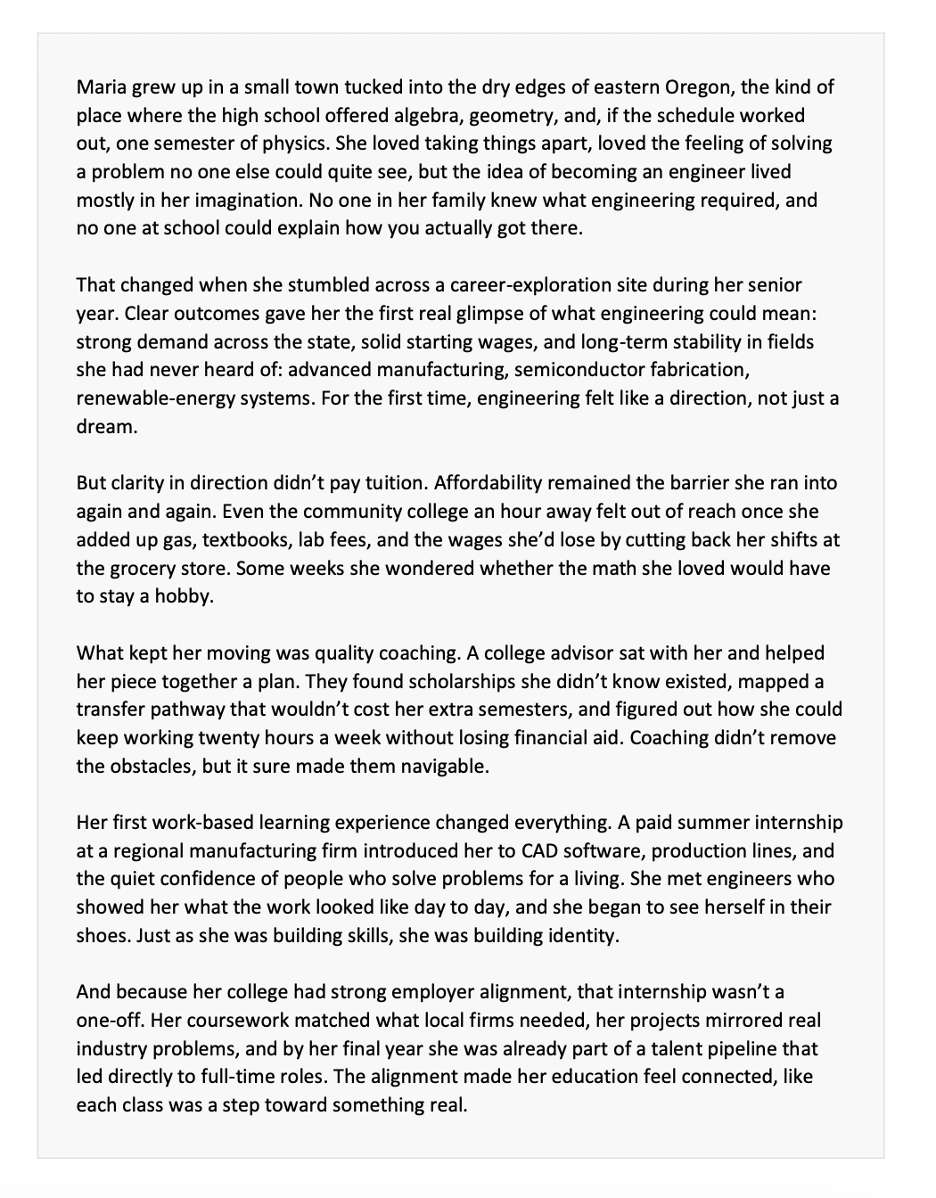
Maria’s story, summarized in Figure 1, shows how the Five Conditions do not operate in isolation. They appear as interlocking supports that structure the possibilities available to learners. Clear outcomes help her see what is possible; coaching helps her navigate what is required; affordability determines whether she can participate; work‑based learning helps her inhabit the role she hopes to grow into; and employer alignment connects her preparation to real prospects for advancement.
Individually, each condition addresses a specific challenge, but, when taken together, they broaden the range of opportunity. Their contribution arises from the way they help learners encounter, pursue, and realize meaningful possibilities. The SOI therefore accomplishes something important. It gives institutional specificity to a broader question: how do educational systems shape the opportunities learners are able to pursue? At the same time, this accomplishment prompts a third fundamental question. If these five domains contribute to opportunity production, what exactly is the phenomenon they are helping to create?
The significance of the Five Conditions becomes clearer once the nature of opportunity itself is examined, since the environments they shape are meaningful only in relation to the phenomenon they are intended to support.
What Is Opportunity?
If Americans were asked what opportunity means, the answers would likely vary across generations, occupations, regions, and lived experiences. A first‑generation college student may associate it with access to higher education. A parent may connect it to economic security and a stable future for their children. An entrepreneur may describe it as the freedom to pursue an idea despite limited resources. Policymakers may frame it through mobility, labor‑force participation, or economic growth. Communities historically excluded from social, political, and economic institutions may understand it through access, participation, and inclusion. These differences reveal a shared expectation that education is meant to expand the possibilities people are able to pursue. Once educational systems are asked to demonstrate opportunity expansion rather than presume it, traditional educational metrics, together with outcomes such as employment, earnings, and mobility, fall short. They provide valuable evidence about educational experiences but do not fully explain what opportunity itself consists of.
The SOI responds to this challenge by foregrounding outcomes that materially shape life trajectories. Employment, economic security, and mobility influence the futures people can pursue, and learners reasonably expect advancement when they invest time, resources, and effort in postsecondary education. By emphasizing these consequences, the Index reframes educational success as a matter of what systems enable people to do once they leave them. This reframing surfaces a deeper conceptual question: do these outcomes capture opportunity, or do they merely express it? Addressing this question requires an interpretive lens capable of explaining how individuals convert resources, supports, and experiences into meaningful possibilities. Capability theory offers such a lens.
Associated most prominently with the work of Amartya Sen and Martha Nussbaum, opportunity concerns the substantive freedoms individuals and communities possess to shape their own trajectories. It can be understood as a condition that emerges from the interaction of capabilities, institutions, relationships, resources, and pathways that shapes what people are genuinely able to pursue. From this lens, the SOI’s Five Conditions take on added significance: they support the capabilities individuals rely upon to pursue meaningful futures, even if they do not constitute a complete theory of opportunity.
Seeing opportunity in these terms invites a broader reconsideration of how educational systems shape peoples’ futures. That reconsideration leads directly to a further question: if opportunity depends on the environments educational systems create, how are those environments themselves generated?
Opportunity Beyond Production
If opportunity depends upon the environments educational systems create, then understanding opportunity also requires understanding how those environments come into being. The State Opportunity Index offers one important answer to that question. The Index identifies five institutional mechanisms through which educational systems shape the informational, relational, financial, experiential, and economic contexts learners encounter. In doing so, it introduces what may be understood as opportunity production: the processes through which educational systems intentionally organize the conditions that expand the possibilities available to individuals and communities. This development represents a critical conceptual advance because it locates opportunity within the institutional processes that shape learners’ educational experiences and subsequent opportunities. Opportunity, understood this way, encompasses outcomes as well as the institutional conditions that contribute to them.
Viewed through this lens, the significance of the Five Conditions becomes readily apparent. Clear outcomes reduce informational asymmetries, enabling learners to recognize and evaluate possible futures. Quality coaching strengthens learners’ capacity to navigate increasingly complex educational pathways. Affordability influences whether opportunities remain practically accessible once tuition, housing, transportation, childcare, technology, and time constraints are taken into account. Work-based learning connects knowledge to authentic practice while supporting the development of competence, confidence, and professional identity. Employer alignment links educational preparation to evolving labor market realities, helping ensure that educational pathways remain connected to meaningful opportunities for advancement.
Taken together, these mechanisms demonstrate how educational institutions reduce uncertainty, expand participation, connect learning to practice, and align educational pathways with evolving economic realities. Collectively, they demonstrate how opportunity production operates within educational systems. Understanding how opportunity is produced is conceptually distinct from understanding opportunity itself. That distinction marks the central contribution of this essay. The Five Conditions identified in the SOI function as necessary contributors to expanding opportunity, but they are unlikely to constitute a complete theory of opportunity itself. They explain important institutional processes through which opportunities are expanded while leaving unresolved a broader conceptual question: What, precisely, is the phenomenon these mechanisms are intended to produce?
A capability lens helps address that question. If opportunity concerns the substantive freedoms individuals and communities possess to pursue futures they have reason to value, then evaluating opportunity requires attention to more than educational participation and observable outcomes alone. It also requires examining the capabilities individuals develop, the relationships they cultivate, the institutional supports they encounter, and the broader social and economic contexts within which they exercise agency. The central line of inquiry, therefore, becomes more demanding. Evaluating opportunity may require asking questions about employment, earnings, and mobility as well as people’s capacity to navigate uncertainty, pursue meaningful aspirations, contribute productively, participate fully in economic and civic life, and continue adapting as circumstances change.
Under this interpretation, the SOI may be understood as identifying an important subset of the institutional conditions through which opportunity is produced. Its framework represents a significant advance because it makes the connection between education and opportunity more explicit. The capability lens builds on that by offering a broader explanation of why the Five Conditions matter and how they interact. This progression prepares the way for a more comprehensive interpretation of the Five Conditions as interconnected components within a broader opportunity architecture.
The Five Conditions Within an Opportunity Architecture
If the State Opportunity Index explains how opportunity is produced, the capability lens helps explain why its Five Conditions matter. It interprets them as complementary components within a broader opportunity architecture. They can be understood as serving distinct but mutually reinforcing capability functions. Each addresses a different dimension of the opportunity environment, while together they organize the informational, relational, financial, experiential, and economic conditions through which individuals develop and exercise agency. Individually, each condition responds to a familiar educational challenge. Collectively, they reveal a coherent architecture through which educational systems intentionally cultivate opportunity. Figure 2 illustrates how these relationships operate within an opportunity architecture.
Figure 2. The Role of the Five Conditions Within an Opportunity Architecture
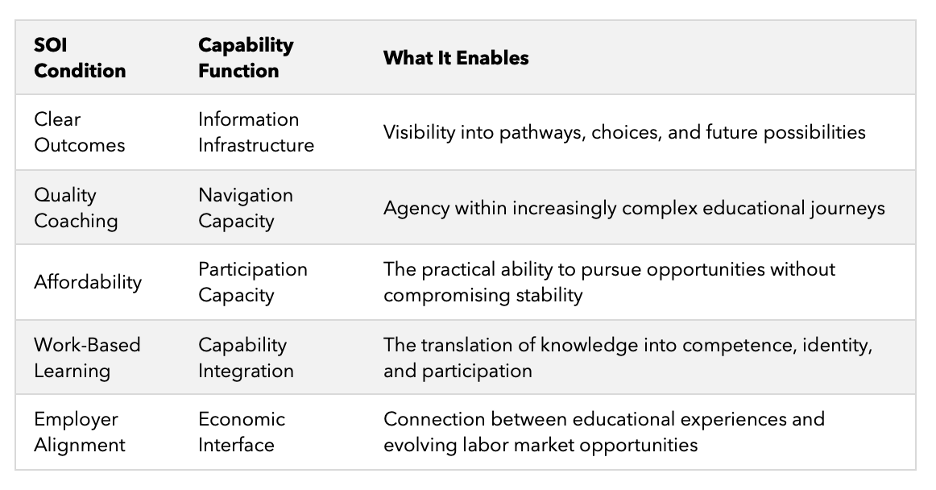
Figure 2 highlights that the explanatory value of the framework lies less in the individual conditions than in the relationships among them. Information without guidance rarely enables informed action. Guidance without affordable pathways cannot overcome structural constraints. Participation without meaningful opportunities to apply knowledge may produce credentials while limiting confidence and professional identity. Likewise, strong educational experiences disconnected from evolving labor market realities may cultivate capable graduates while reducing the opportunities available to them after completion. The Five Conditions therefore derive much of their value from their interaction rather than from their independent effects. Because the relationships among the Five Conditions shape their overall contribution, educational systems assume a broader role than is often acknowledged. Educational systems provide instruction, confer credentials, facilitate employment, and coordinate the supports through which learners recognize possibilities, navigate complexity, participate meaningfully, develop capabilities, and connect educational experiences to evolving social and economic opportunities.
Understanding opportunity in these terms also broadens how institutional effectiveness can be understood. Individual initiatives remain central but depend increasingly on the coherence of the larger system within which they operate. The Five Conditions function as mutually reinforcing components whose relationships strengthen the overall opportunity architecture. Clear pathways support effective coaching, coaching helps learners sustain participation, work-based learning integrates knowledge with authentic practice, and employer alignment connects those capabilities to evolving opportunities. Their collective value resides in the coherence of the opportunity architecture they create.
The State Opportunity Index in this view provides a foundation for understanding how educational systems organize opportunity-producing systems. Capability theory reveals the deeper logic connecting the Five Conditions by explaining how they function collectively to enlarge the possibilities available to individuals and communities. Integrating these ideas positions the SOI within a broader conceptual model for understanding how educational systems intentionally cultivate the institutional arrangements through which human possibility expands.
Conclusion
For nearly two centuries, Americans have looked to education as one of the nation’s most enduring pathways to opportunity. Horace Mann’s vision of education as “the great equalizer of the conditions of men” reflected a belief that expanding educational access would ultimately expand human possibility. That promise remains as compelling today as it was in the nineteenth century. What has changed is the complexity of demonstrating how that promise is realized.
The State Opportunity Index represents a critical step in that evolution. It recognizes that educational success can no longer be inferred from participation, completion, or attainment alone. Instead, institutions are increasingly expected to demonstrate that educational experiences contribute meaningfully to the futures learners are able to pursue. By directing attention toward the institutional conditions associated with opportunity, the Index advances the conversation beyond traditional educational metrics and toward a richer understanding of educational effectiveness. Capability theory advances the discussion by explaining opportunity itself. Opportunity concerns the substantive freedoms individuals and communities possess to pursue futures they have reason to value. Educational systems are therefore evaluated through learners’ achievements, capabilities, recognized possibilities, and exercised agency.
The SOI and capability theory explain different aspects of educational opportunity. The Index identifies institutional conditions through which opportunity is expanded, while capability theory explains why those conditions matter and how they enlarge the substantive freedoms individuals possess to pursue meaningful futures. Integrating them provides a stronger conceptual foundation for evaluating how educational systems contribute to human flourishing.
The enduring promise of education, then, does not require reconsideration. Our understanding of opportunity does. As educational systems assume greater responsibility for demonstrating their contribution to individual and community flourishing, they will require conceptual frameworks capable of explaining both educational outcomes and the processes through which opportunity is created, expanded, and sustained. The SOI has opened that conversation. The task now is to continue it with conceptual tools equal to the complexity of the challenge.
Notes
1. Strata Education Foundation. State Opportunity Index 2025.
2. Mann, Horace. Twelfth Annual Report of the Secretary of the Massachusetts Board of Education. 1848.
3. Sen, Amartya. Development as Freedom. Anchor Books, 1999.
4. Nussbaum, Martha C. Creating Capabilities: The Human Development Approach. Harvard University Press, 2011.