
Hillsboro Shared Equity Homeownership Options Scan: How Ownership Design Shapes Access, Lasting Affordability, and Resident Control
Executive Summary
As Hillsboro considers ways to expand affordable homeownership, shared-equity housing deserves examination. These arrangements generally use a subsidy, resale restriction, or both to reduce a buyer’s entry cost and preserve some affordability for future buyers. Whether an arrangement helps households buy and sustain a home depends on actual buyer costs, available homes and their locations, financing, and resale terms. This scan compares four approaches and considers how each assigns resident control and stewardship responsibilities.
Hillsboro has a documented local starting point. Its Housing Production Strategy identifies an ongoing partnership with Proud Ground to acquire and rehabilitate homes, and the City reported five acquisitions during its July 2024–June 2025 program year (City of Hillsboro, 2025a, 2025d). The City also identifies Habitat for Humanity’s Century Commons and Alder Commons developments, undertaken with Proud Ground, as community land trust (CLT) homes. The Strategy lists 18 homes at Century Commons and eight at Alder Commons (City of Hillsboro, 2022, 2025d). These developments and the five reported acquisitions are different activities. A next review would need completed-sale information, buyer costs and terms, and current availability to show what these CLT efforts have meant for buyers. Proud Ground’s down-payment grant is examined separately from the reported acquisition work.
The three other approaches are limited-equity cooperatives (LECs), CLT–cooperative hybrids, and deed-restricted individual ownership. Rosa Village in Eugene provides an Oregon example of a hybrid under development, illustrating how land stewardship and cooperative resident governance could be combined (SquareOne Villages, n.d.). The records reviewed did not identify a comparable Hillsboro project using any of these three approaches.
Proud Ground’s CLT work therefore provides the clearest documented institutional starting point in Hillsboro, not a basis for ranking the four models. Choosing among them would require comparable costs and agreements for defined projects, including how each would be financed, governed, and permitted on its proposed site. This scan identifies the questions residents, housing organizations, and public decision-makers would need to resolve before making that judgment.
1 What Hillsboro’s Policy and Activity Records Establish
Hillsboro’s policies leave room for several shared-equity approaches, but the activity records reviewed give the clearest local evidence for community land trusts. The 2023 Housing Needs Analysis identifies CLTs, down-payment assistance, and cooperatives as possible tools for reaching prospective owners. Housing Policy H 2.2 in the Comprehensive Plan encourages condominiums and cooperatives, including limited-equity cooperatives. Action 3.2 of the Housing Production Strategy calls for continuing the City’s Proud Ground partnership, seeking other partners, and facilitating at least two new affordable-homeownership projects (City of Hillsboro, 2023, 2025c, 2025d).
The City’s annual performance report provides a different kind of evidence. It records five home acquisitions through the Proud Ground partnership during July 2024–June 2025, against a target of four. A federal draw report lists $311,250 for Proud Ground Housing Acquisition 24-25 (City of Hillsboro, 2025a). Acquisition is one stage in bringing a home into the program. The reported count does not establish whether those homes were rehabilitated and sold, whether any are available now, or what buyers have experienced.
Hillsboro also identifies two new-home developments using the CLT model. Habitat for Humanity partnered with Proud Ground on Century Commons and Alder Commons, which the City described as permanently affordable CLT homes. The Housing Production Strategy identifies 18 homes at Century Commons and eight at Alder Commons (City of Hillsboro, 2022, 2025d). These development counts describe a different activity from the five existing-home acquisitions reported for July 2024–June 2025. To learn what the developments offered buyers, the next review would need completed-sale information and the prices, financing, and resale terms of the homes.
The City’s 2025–26 annual plan targets five additional acquisitions and identifies planned funding for that work (City of Hillsboro, 2025b). That target is separate from the five acquisitions reported for the prior year. Together, the acquisition work and the two developments make the CLT model the clearest documented local case to examine. Comparing it with the other three approaches would also require a defined Hillsboro project or proposal using another model.
2 Four Ownership Arrangements Compared
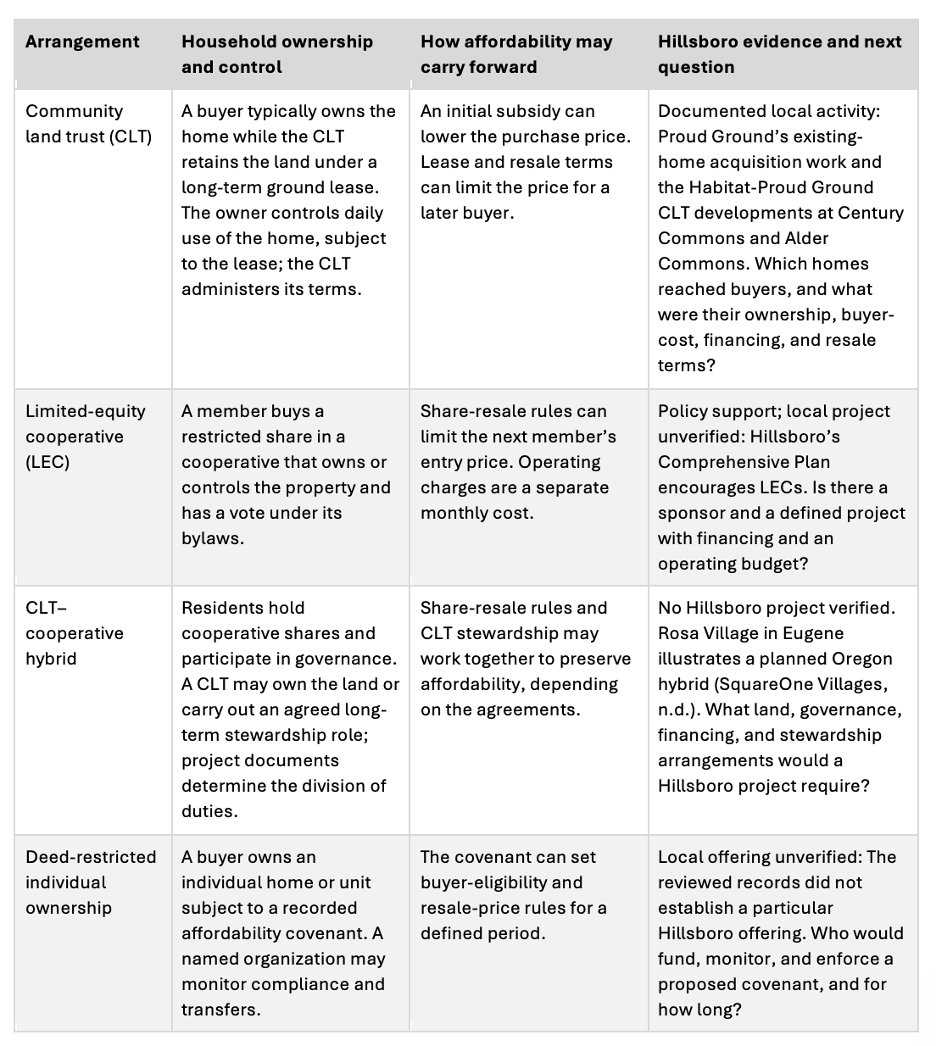
The four approaches differ in what a household owns, which decisions residents make, and how the home remains affordable for a later buyer. The descriptions below explain typical arrangements. The lease, cooperative bylaws, financing documents, or recorded covenant would determine the rights and costs in any specific project (Ehlenz & Taylor, 2019; Saegert & Benítez, 2005).
3 From Eligibility to Lasting Access
The four arrangements described above differ in what buyers own and how affordability is preserved. For a household, however, each raises a sequence of practical questions: Can the household meet the program’s requirements, find an available home and complete the purchase, afford to remain there, and leave the home within reach of a later buyer? Proud Ground’s Hillsboro down-payment grant makes the first steps concrete within the CLT approach. A home purchased with the grant enters Proud Ground’s CLT (Proud Ground, n.d.-a). Section 6 calls for checking whether any such purchases overlap with the City-reported acquisitions.
Proud Ground’s Hillsboro grant program illustrates how eligibility, mortgage, and cash requirements can shape entry into a CLT home. Applicants must live or work in Washington County, be first-time buyers, meet an income limit based on household size, and purchase a home in Hillsboro. The published limit for a four-person household is $102,650. The grant page also calls for qualification for a mortgage of at least $255,000 through a participating lender, earnest money of at least 1% of the purchase price, and $3,000 in separate savings. Its debt-to-income limits are 40% for housing costs and 47% for total debt. Assistance can reach $150,000, but the amount depends on need (Proud Ground, n.d.-b). These grant-specific thresholds provide an example of the buyer information needed for any particular offering, not a standard shared by all four approaches.
Meeting those requirements still does not mean a household can buy. It also needs a suitable home and an available grant. On November 2, 2026, Proud Ground’s assistance page labeled the Hillsboro grant available, and its grant page listed one grant available, with complete applications reviewed in the order received (Proud Ground, n.d.-a, n.d.-b). Because availability can change, a prospective buyer would need to confirm it when applying. Application and purchase records would be needed to learn how many households complete a purchase and how long that takes. The same gap between eligibility and purchase matters for all four approaches as a household also needs an available home, financing, and enough cash to complete the sale.
Once a household buys, can it afford to stay? Stone (2006) argues that a housing-cost-to-income ratio cannot show whether enough income remains for other necessities. For any of the four approaches, answering that question would require a specific home or cooperative share, a defined household and date, and a complete budget covering purchase costs, recurring housing costs, and essential non-housing expenses.
At resale, the question shifts to whether the home remains within reach of another eligible household. Resale terms affect both what the departing owner receives and what a later buyer must pay. Temkin et al. (2013) examined resales in seven established programs: three CLTs, two limited-equity cooperatives, and two deed-restricted programs. In five, the income needed to buy a home at resale stayed relatively close to the income needed at its earlier sale when each was measured against local median income; affordability declined more in the other two. Because the study included neither a CLT–cooperative hybrid nor a Hillsboro home, its findings cannot settle the local question. Instead, they show why a defined project’s resale formula and the resulting price relative to eligible buyers’ incomes need to be examined.
4 What Buyers Gain, Take On, and Pass Forward
Getting into a home is only part of the ownership experience. Resale value affects what an owner may gain financially, resident control brings both influence and responsibilities, and location shapes what the home offers this household and the next. For a departing owner, the financial question is what the home’s resale terms allow them to receive after the costs of selling. A resale formula can limit appreciation while keeping the price within reach of a later buyer, but the result depends on the formula and the costs the owner faces. Temkin et al. (2013) found that sellers in seven shared-equity programs earned returns on their initial investments that compared favorably with hypothetical stock or bond investments. Measuring housing-wealth accumulation differently, Acolin et al. (2021) found positive but modest gains among shared-equity participants, somewhat below those of comparable unrestricted homeowners. Neither study can predict how much money someone buying a shared-equity home in Hillsboro would receive when they sell it. Estimating that amount for a particular home would require its purchase price and resale formula, an assumed sale date, the remaining mortgage balance, and selling costs. The resulting resale price would also need to be compared with what a later eligible buyer could afford.
The influence residents can exercise, and the responsibilities they assume, depend on how each arrangement assigns decisions. An owner of an individual CLT or deed-restricted home makes day-to-day decisions about that home within the terms of its agreements. In an LEC, members may vote on collective matters, while also sharing responsibility for budgets, repairs, and reserves. Saegert and Benítez (2005) describe the governance and management demands of this arrangement. A CLT–cooperative hybrid adds a further question: which decisions belong to cooperative members, and which belong to the land steward? Bylaws and operating budgets would show formal authority and financial duties, including how monthly charges, repairs, reserves, and missed payments are handled. Residents’ accounts would help show whether members have the information, support, and influence to exercise those rights in practice.
Location is another part of what a household receives and what a later buyer may experience. A well-connected home may ease travel to jobs, schools, and services; a different site may impose greater transportation costs even if its purchase price is lower. Ramiller et al. (2024) found that moves into shared-equity homes in their sample were associated, on average, with higher-poverty neighborhoods, lower school-quality measures, and higher transportation costs than households’ prior locations. Those associations do not establish that the ownership arrangement caused the differences or that they describe Hillsboro homes. They make the practical question site-specific: how would a candidate home’s location affect the daily costs and opportunities of the households it is intended to serve?
5 Funding and Local Land-Use Screens
Whether a shared-equity arrangement could work in Hillsboro depends on matching a defined project with development funding, support for buyers, and the land-use rules for its site. State development funding is one possible part of that match. Oregon’s LIFT Homeownership program offers development financing for qualifying new homes and conversions of nonresidential buildings. Its 2026–27 manual identifies CLTs and LECs among possible shared-equity structures and requires an eligible land-holding arrangement, a long-term stewardship plan, and homes affordable to households earning no more than 80% of area median income. Affordability must continue for at least 20 years after every home in the project is sold (Oregon Housing and Community Services, 2026). A cooperative or hybrid sponsor would need to show how its particular arrangement meets the applicable funding requirements.
City and county support can help at different points, from providing land for homes to assisting buyers with a purchase. Hillsboro has supported CLT homeownership by donating land for Habitat for Humanity developments and directing federal funds to Proud Ground’s land-trust work (City of Hillsboro, 2022). Washington County’s First Home program has supported both down-payment assistance and permanent affordability through CLT purchases. Its 2025 report records 17 Hillsboro purchases across the program, without breaking out which used a CLT or how they relate to the City-reported acquisitions and Habitat developments. Those counts cannot yet be combined (Washington County, 2025). The County’s January 2026 awards to Habitat for Humanity Portland Region and Portland Housing Center were for down-payment assistance (Washington County, 2026). For future projects, Hillsboro’s Housing Production Strategy proposes identifying City-owned sites and soliciting homeownership partners through a process that could offer land or funds (City of Hillsboro, 2025d, pp. 70, 75–76). A sponsor would need to identify an available opportunity and determine what costs and buyer assistance its project would still need to cover.
Even if a project qualifies for funding, its proposed site and housing type must also meet the City’s land-use rules. A sponsor would need to identify the site’s zoning and the rules for its proposed housing type, then determine whether ordinary zoning or a special affordable-housing pathway applies. Hillsboro’s Community Development Code includes a Senate Bill 8 pathway for qualifying affordable housing, subject to conditions concerning affordability, ownership or zoning, and site suitability. That pathway requires at least 30 years of enforceable affordability. The code’s separate definition of regulated affordable housing also specifies a compliance agreement, an income threshold, and at least 30 years of affordability from occupancy (City of Hillsboro, 2026, §§ 12.01.500, 12.40.107[A]). A sponsor considering LIFT alongside a City code pathway would need to test its site and agreements against both sets of requirements, including the applicable affordability term.
6 What Hillsboro Would Need to Verify Next
Hillsboro’s reported CLT activity can be examined more closely now. Comparing it with another local approach would require a defined project and evidence of what specified households would pay and take on.
Trace Hillsboro’s documented CLT activities separately. For the City-reported acquisitions through Proud Ground, obtain the partnership agreements and acquisition, rehabilitation, sale, and financing records to determine which homes reached buyers and on what terms. Review Proud Ground’s down-payment grant through its own application and purchase records, checking whether any grant-assisted purchases overlap with the reported acquisitions. Seek a program-level breakdown of Washington County’s 17 Hillsboro First Home purchases by assistance type and project, and check whether any overlap with the other reported activities. For the Habitat–Proud Ground developments, review project agreements and completed sales to establish buyer prices, financing, and resale terms. Together, those records could establish which homes reached buyers and on what terms, while keeping the different programs’ counts separate.
Identify a defined Hillsboro alternative. The reviewed records did not establish a particular local LEC, hybrid, or deed-restricted offering. An organization proposing an LEC, hybrid, or deed-restricted project would need to identify a site, ownership and resale terms, capital sources, an operating plan, and a long-term steward. Its proposal would also need to show which funding conditions and land-use provisions apply. Those details would permit a comparison of documented arrangements and projected costs with Proud Ground’s pathway, not a comparison of completed household outcomes. If no alternative project is identified, Proud Ground’s work can still be studied, but a local project-to-project comparison cannot yet be made.
Test costs and responsibilities for specified households. For each defined project or available home, a comparison would need a common date and clearly stated assumptions about household size, income, financing, and necessary expenses. Records for completed homes could provide actual buyer prices and charges. An unbuilt proposal would instead require documented cost estimates and financing assumptions. Governing documents could establish maintenance, resale, and stewardship duties, while transportation and location evidence could help assess access to jobs and services. For completed homes, residents’ accounts could show how those formal rights and duties worked in practice. A resale scenario would also need the project’s resale formula, an assumed sale date, the remaining mortgage balance, selling costs, and a test of what a later eligible buyer could afford.
These checks would help assess whether a defined project could work under specified conditions. Deciding which approach is preferable would also require an explicit choice about the weight given to entry cost, long-term affordability, resident control, location, and implementation capacity.
7 Conclusion
Hillsboro’s reported existing-home acquisitions and its Habitat–Proud Ground developments provide the clearest documented local CLT activity to investigate. Sale and financing records could establish which homes reached buyers and on what terms. Residents’ accounts could add how ownership worked in practice. The other three approaches can be compared as ownership arrangements, but judging what they could offer in Hillsboro requires defined local projects and comparable evidence. Rather than rank the models now, this scan gives residents and decision-makers a way to ask what a particular project would let a household afford and control, what responsibilities and location it would bring, and how affordability would carry forward to the next buyer.
References
Acolin, A., Ramiller, A., Walter, R. J., Thompson, S., & Wang, R. (2021). Transitioning to homeownership: Asset building for low- and moderate-income households. Housing Policy Debate, 31(6), 1032–1049. https://doi.org/10.1080/10511482.2021.1949372
City of Hillsboro. (2022, December 27). Affordable home ownership in Hillsboro: Two new developments breaking ground. https://www.hillsboro-oregon.gov/our-city/news-announcements/-item-14274
City of Hillsboro. (2023). Housing needs analysis report. https://www.hillsboro-oregon.gov/home/showpublisheddocument/30247/638415093176330000
City of Hillsboro. (2025a). 2024 consolidated annual performance and evaluation report. https://www.hillsboro-oregon.gov/home/showpublisheddocument/32297/639032966979100000
City of Hillsboro. (2025b). 2025 annual action plan. https://www.hillsboro-oregon.gov/home/showpublisheddocument/32295/639032963018030000
City of Hillsboro. (2025c). Hillsboro comprehensive plan (amended through December 16, 2025). https://www.hillsboro-oregon.gov/our-city/departments/community-development/codes-standards/comprehensive-plan
City of Hillsboro. (2025d). Hillsboro housing production strategy: Cycle 1, 2025–2030. https://www.hillsboro-oregon.gov/our-city/departments/community-development/projects/housing-production-strategy
City of Hillsboro. (2026). Community development code (Supp. No. 1, May 2026). https://library.municode.com/or/hillsboro/codes/community_development_code
Ehlenz, M. M., & Taylor, C. (2019). Shared equity homeownership in the United States: A literature review. Journal of Planning Literature, 34(1), 3–18. https://doi.org/10.1177/0885412218795142
Oregon Housing and Community Services. (2026). Local Innovation and Fast Track homeownership program manual. https://www.oregon.gov/ohcs/homeownership/documents/ho%20development/2026-2027-lift-manual-ua.pdf
Proud Ground. (n.d.-a). Down payment assistance grants. Retrieved November 2, 2026, from https://www.proudground.org/down-payment-assistance
Proud Ground. (n.d.-b). Hillsboro downpayment assistance grant. Retrieved November 2, 2026, from https://www.proudground.org/washington-county-downpayment-assistance-grant
Ramiller, A., Acolin, A., Walter, R. J., & Wang, R. (2024). Moving to shared equity: Locational outcomes for households in shared equity homeownership programs. Housing Studies, 39(5), 1239–1263. https://doi.org/10.1080/02673037.2022.2115467
Saegert, S., & Benítez, L. (2005). Limited equity housing cooperatives: Defining a niche in the low-income housing market. Journal of Planning Literature, 19(4), 427–439. https://doi.org/10.1177/0885412204274169
SquareOne Villages. (n.d.). Rosa Village Co-op. Retrieved October 12, 2026, from https://www.squareonevillages.org/villages/rosa
Stone, M. E. (2006). What is housing affordability? The case for the residual income approach. Housing Policy Debate, 17(1), 151–184. https://doi.org/10.1080/10511482.2006.9521564
Temkin, K. M., Theodos, B., & Price, D. (2013). Sharing equity with future generations: An evaluation of long-term affordable homeownership programs in the USA. Housing Studies, 28(4), 553–578. https://doi.org/10.1080/02673037.2013.759541
Washington County. (2025, June). Housing Production Opportunity Fund First Home program report. https://www.washingtoncountyor.gov/commdev/documents/first-home-program-report-2025/download?inline=
Washington County. (2026, January 6). Approve First Home program funding awards for affordable homeownership and authorize execution of contracts with Habitat for Humanity Portland Metro Region and Portland Housing Center (MO-26-1). https://washingtoncounty.civicweb.net/document/320436/